The Connective Issues

Your biology is interconnected. Your medical records are not.

Your health history is more than a list of test results. It includes experiences, unanswered questions, and details that make sense only when considered in context.

The Connective Issues was founded to bring those pieces together into a coherent diagnostic strategy, starting with believing your symptoms.

Does any of this sound familiar?

  • Your symptoms have changed over the years, and you’re trying to understand which details belong in the bigger picture.
  • You have a diagnosis, but some of your symptoms or clinical findings still don't have a clear explanation.
  • You're considering genetic testing, or you've already received results and want to understand what they actually tell you.
  • You've come across research that seems relevant to your health, and you're wondering how strong the evidence is and whether it applies to your situation.

My work began with connective tissue disorders, but these challenges aren't unique to any one diagnosis. If you're navigating a complicated health history and trying to understand how the information fits together, this approach may offer a useful way to begin.

Your health history deserves a closer look.

Trying to explain years of symptoms in one appointment can be difficult, especially when the information is scattered across different specialists and medical records.

Even details that seem small at first may be worth a closer look. A symptom that started years before a particular treatment raises different questions from one that appeared afterward, while an unusual laboratory result, a pattern in your family history, or something you’ve experienced since childhood may add context that isn’t obvious from a list of diagnoses.

That's where my Phenotype Mapping Method begins.

I bring together your experiences, clinical findings, family history, and how things have changed over time, while keeping track of what was documented, what you've observed, and what remains uncertain.

Then I draw on my background in molecular genetics and laboratory diagnostics to explore possible biochemical explanations and the research behind them.

I’m interested in the connections that seem to fit, but I pay just as much attention to findings that challenge an explanation. Some things may be related while others have entirely different causes, so understanding what doesn’t fit can be just as useful as finding a connection.

The goal is to give you and your healthcare team a clearer account of your history, along with more focused questions about what might be worth investigating next.

Explore the Phenotype Mapping Method

Join the waitlist to be notified when consultation bookings open.

Start with the question you're trying to answer.

I'm considering genetic testing.

A clinician may have recommended a test, or you may be comparing a panel, an exome, and a genome service yourself. Each has different methods, limits, reports, and follow-up arrangements. The useful place to start is what you hope testing will help clarify.

Before You Buy a Genetic Test is a 120-page educational guide that explains those differences and gives you a seven-question comparison, a detailed worksheet, and a checklist to use before paying or sending a sample.

Explore the Genetics Guide

I already have genetic results.

A report may contain unfamiliar terminology, uncertain findings, or a negative result that still leaves you wondering what was assessed.

Learn how to read genetic information in context and explore the educational review services currently being developed.

Explore Genetic Education

My health history is complicated.

When records span multiple specialties, a structured history can help preserve the chronology, reported experiences, documented findings, and unresolved questions.

Learn about the Phenotype Mapping method and the app being developed to support that process.

Understand the Method

I want to explore the research.

Scientific papers can offer important insight, but understanding what a study actually investigated is just as important as reading its conclusions.

Explore research explanations and the original publications behind them.

Explore the Research Libraries

Educational resources from The Connective Issues support understanding and informed conversations. They don't replace medical diagnosis, treatment, or genetic counseling.

“

How I approach your history

I start by taking your symptoms and experiences seriously, including details that haven’t made it into your medical record. Together, we translate those experiences into medical language and organize them into a coherent phenotype: a detailed picture of your symptoms, history, and clinical findings. I connect that picture with relevant research and biochemical clues to help your care team see the whole picture, investigate possible explanations, and work toward a diagnosis.

The Phenotype Mapping app is in development. In the meantime, you can explore the educational resources and research that inform this approach.

Learn About Phenotype Mapping

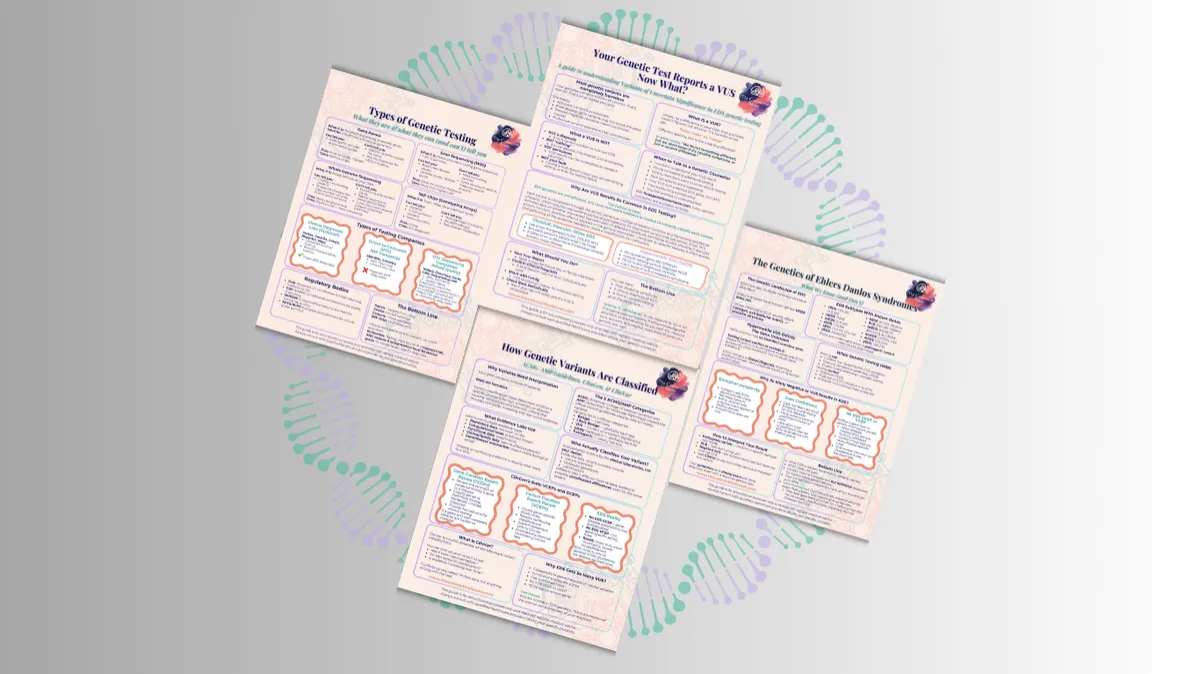
Free Genetic Testing Handouts

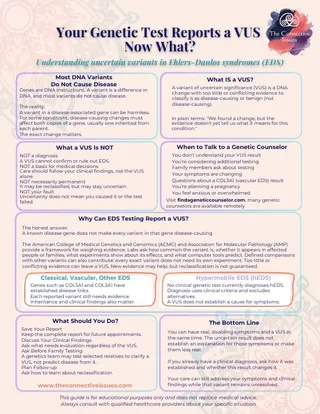
Have you ever opened a genetic test result and felt completely lost?
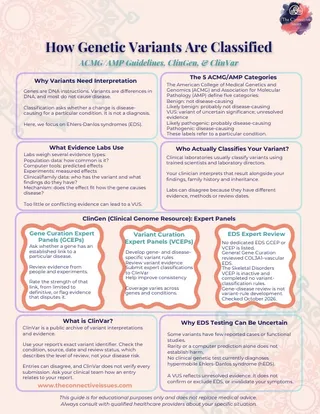
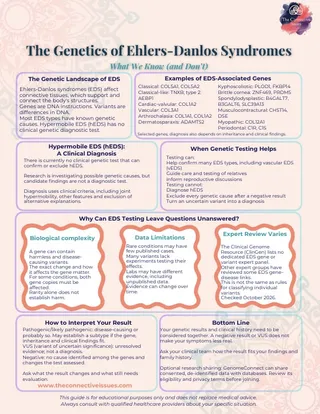
You are definitely not alone! Genetic testing for connective tissue conditions is incredibly complex, and the results rarely come with clear instructions. I created four free visual handouts to help you decode the process.

Download the bundle to learn:

  • The difference between Gene Panels, Exome, and Genome sequencing (and why tests like 23andMe cannot diagnose you).

  • Why Variants of Uncertain Significance (VUS) are so common in EDS.

  • How laboratories actually classify your variants using ACMG guidelines.

  • The current reality of hEDS genetics and what your test can and cannot tell you.

Research worth understanding.

Explore the evidence, including its limitations.

The Connective Issues offers two ways to investigate scientific literature.

Research Breakdowns

A Research Breakdown follows a study from the question that motivated it through the methods, results, and limitations. I also want to understand why a particular interpretation seems convincing, and what the research would need to show before we could be more confident.

Reference Library

The Reference Library helps you locate selected publications by topic and follow the original sources. It's there for readers who'd rather check the evidence themselves, including the parts that complicate a neat conclusion.

Research can help you develop better-informed questions. Applying a study to an individual's health requires clinical context and qualified professional evaluation.

Browse Research Breakdowns

Explore the Reference Library

The Connective Issues Blog

If you'd like to learn more about genetics, connective tissue biology, complex health conditions, and the research behind them, you can follow The Connective Issues through the blog and educational updates.

Read the Blog

Explore the Resources

Resources

When you’re looking for answers about chronic illness, finding a paper is only the beginning. You need to know what it says, how strong the evidence is, and whether it helps answer the question you’re asking.

My own diagnostic journey led me to build a collection of research on connective tissue disorders and related conditions. These two libraries let you explore the original studies and follow my thinking as I work through selected papers.

Copper-toned scientific reference books on navy

Reference Library

Start with the research behind your question.

Browse selected papers by topic, including foundational studies, and follow the citations to the original sources. Use the library to see what has been studied and find questions you may want to explore further.

Explore the Reference Library →
Copper-toned scientific papers and a magnifying lens on navy

Research Breakdown Library

Take a closer look at the evidence.

Explore plain-language breakdowns of selected papers: what the researchers asked, what they found, and what the evidence can actually support.

Original references and the research-focused slides I’ve shared on social media are kept together so you can return to the explanation when you need it.

Explore Research Breakdowns →

Start with the question that matters to you

Your Guiding Question is the specific question about your health that you want the next step in your care to help answer. It acts as a North Star for the investigation, without deciding the answer in advance. New information may change what seems most likely or reveal a different question to ask.

That question might concern a genetic result, a pattern in your health history, or research you've encountered. Understanding what is already known, where the information came from, and what remains uncertain can help make the discussion with your care team more specific.

Research, consulting, and education

The Connective Issues examines scientific literature, develops educational resources, and approaches consulting through careful attention to the person's question and the evidence available. Research needs context: what a study investigated, what it found, and how far its conclusions can reasonably extend. The same care matters when connecting scientific information with an individual health history.

For a general question, collaboration inquiry, or an introduction to the consulting inquiry process, visit the Contact page. Please don't send medical records or detailed health information in a general message.

The Connective Issues does not diagnose, prescribe, or replace medical care or genetic counseling.

Retained prior introduction

When your symptoms, test results, and medical history are spread across years of appointments, the question you need help with can get lost in the details. The Connective Issues brings scientific research and diagnostic-strategy consulting to that problem, with education that helps you understand the evidence and take part in the conversation.

Founded by Jaime M. Prout, PhD, The Connective Issues connects work in genetics, molecular diagnostics, and research translation with the practical questions people bring to their healthcare teams. The aim is to make your history and the relevant science easier to examine, while keeping possible explanations separate from established findings.

Retained prior method explanation

The Phenotype Mapping Method starts with a person's symptoms and experiences, including details that may be poorly documented in medical records. Those experiences are translated into medical language and brought together with clinical findings, family history, and the sources behind them.

Together, this helps build a detailed picture of the person's symptoms, history, and clinical findings, called a phenotype. Relevant research can then be considered alongside that history to build possible biological explanations. Those explanations remain questions to discuss, investigate, and revise with healthcare providers, rather than confirmed diagnoses.

This describes the approach behind The Connective Issues. The scope of any individual consulting work has to be discussed separately; this page isn't an offer of a particular service or a promise of a diagnosis.
Free genetics guides

Make sense of the language around genetic testing

If you’re considering genetic testing or trying to understand a report, these four guides explain concepts that can otherwise make the process harder to follow.

Use them to get familiar with testing options, understand the language of a result, and prepare more focused questions for your healthcare team.

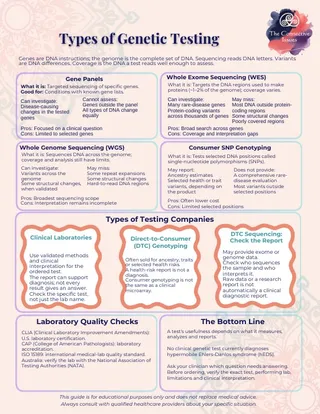
  • First page of the Types of Genetic Testing guide

    Types of genetic testing

    See how different tests examine different parts of your genetic information.

  • First page of the VUS guide

    Understanding a VUS

    Learn what a variant of uncertain significance (VUS) can and cannot tell you.

  • First page of the genetic variant classification guide

    Variant classification

    Explore how laboratories use evidence to classify genetic changes.

  • First page of the Ehlers–Danlos genetics guide

    EDS genetics

    Understand the role and limits of genetic testing in Ehlers–Danlos syndromes.

Get the guides

Services

Services in development

Diagnostic Strategy Consultations

Join the consultation waitlist

When your health history is complicated, where do you even begin?

Maybe you’re considering genetic testing and want to understand what it could actually tell you.

Maybe you already have results but aren’t sure what they mean in the context of your symptoms.

Or perhaps you’ve spent years collecting medical records and wondering whether there’s something important in the history that deserves another look.

Diagnostic Strategy Consultations bring my background in molecular genetics, clinical diagnostics, bioinformatics, and patient advocacy to those questions.

Depending on your needs and the agreed scope, we may work on understanding genetic testing options, organizing your clinical history, examining scientific evidence behind possible explanations, or preparing clearer questions and summaries for your healthcare team.

I’m interested in the connections you’re considering and why they make sense to you. We’ll look at what the available evidence supports, what remains uncertain, and which questions may be worth investigating further.

Sign up to be notified when consultation bookings open, and tell me what you’re hoping to understand. You don’t need to choose a service first.

Join the waitlist

My work provides scientific education and evidence-focused support, not diagnosis, treatment, or formal genetic counseling.

Please don’t submit medical records, genetic reports, sequencing files, or detailed health information through the interest form.

Resources

Sequencing Reanalysis

Join the waitlist

If you already have sequencing data, could another look tell us something new?

A whole-exome or whole-genome test generates substantial genetic data, but the original analysis may have focused on certain genes or clinical questions, and the report may include only selected findings.

What those data can tell us may also change as scientific knowledge develops.

Sequencing Reanalysis is a separate, more specialized service for revisiting existing sequencing data with a defined scientific question, relevant clinical history, and current evidence.

Depending on your case and the data files available, I may examine potentially relevant findings, review newer evidence linking genes to disease, and explore how those findings fit your clinical history.

Sometimes another analysis identifies a useful lead.
Sometimes it helps explain why a proposed connection isn’t well supported.
And sometimes the available data or evidence simply can’t answer the question yet.

Interested in sequencing reanalysis? Join the waitlist to be notified when bookings open, and mention sequencing reanalysis in your interest form.

Join the Waitlist

This is scientific evidence review, not a new clinical laboratory report, medical diagnosis, treatment recommendation, or formal genetic counseling.

Please don’t send sequencing files, genetic reports, medical records, or detailed health information through the interest form.

Research Breakdown Library

Patient-focused explanations of individual studies, including what researchers asked, what they found, and the limits of the evidence, with source links for further reading.

Coming soon

Reference Library

A searchable collection of selected scientific papers organized by topic, with citations and links to the original sources.

Coming soon

Patient Voices

What happened when you tried to get answers about your health?

The first thing I did when setting up The Connective Issues was check in with the people I hoped would benefit most: patients with diagnosed or suspected connective tissue disorders. I wanted to understand what you needed, what was getting in the way, and where support could make a difference.

The turnout was amazing, with more than 250 responses to that first survey. Now I want to focus more closely on the healthcare experiences you remember most, good or bad, and how they shaped what happened next.

If you’re 18 or older and have a diagnosed or suspected connective tissue disorder, I’d like to hear about one experience that stayed with you. Please leave names and other identifying details out of your answers.

This survey supports education and advocacy. Quote permissions and future contact are separate choices; taking part doesn’t sign you up for marketing emails.

Meet Jaime

Welcome!

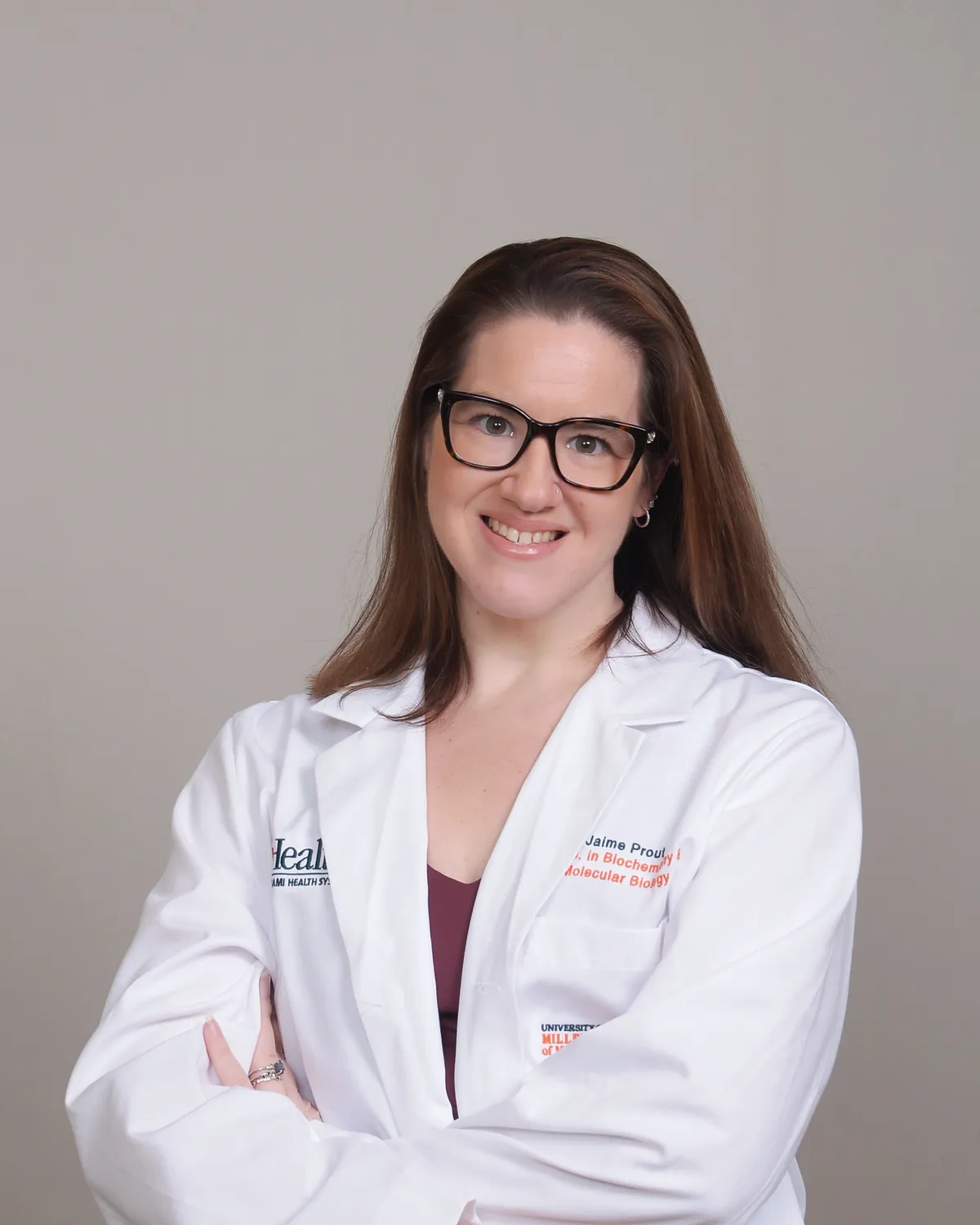
As a fellow patient with a complex health history, I know how much work it can take to turn that stack of results and a lifetime of symptoms into a conversation with your medical team that actually accomplishes something.

My professional background spans genetic medicines, molecular diagnostics, and clinical assay development. That background gave me a strong scientific foundation to draw on during my own and my family’s diagnostic journeys.

Those experiences showed me how easily patients without a strong biology background could fall through the cracks in our fractured healthcare system.

That recognition led me to turn my professional focus to patient advocacy. I founded The Connective Issues to bring my scientific background and patient experience together, helping people make sense of complex information and prepare for more productive conversations with their healthcare teams.

The Connective Issues is built on four pillars that reflect what I bring to this work:

✦ Science

✦ Education

✦ Lived Experience

✦ Patient Advocacy

Together, they shape my consulting practice, the content I create, and the Phenotype Mapping Method, my approach to bringing the pieces of a complex health history together.

Jaime M. Prout

  • PhD
    Biochemistry and Molecular Biology

  • Certified Clinical Laboratory Scientist
    MB(ASCP)

  • Board Certified Patient Advocate
    BCPA

  • Career in Molecular Diagnostics
    and Genetic Medicines

Questions, ideas, or an interest in working together?

Have a question about a resource or a topic you’d like to understand better? Suggestions for future content are welcome, as are ideas for research, education, and patient advocacy collaborations.

Email [email protected].

Looking for help with genetic testing or a complicated health history? Use the consultation interest form to share what you’re hoping to understand. Join the waitlist to be notified when consultation bookings open.

Please keep your message general. Don’t send medical records, genetic reports, sequencing files, or detailed health information by email or through the interest form.

Stay in the loop

Newsletter signup — Coming soon

The Connective Issues — DNA and magnifying glass

View our Privacy Policy and Terms and Conditions here.

© The Connective Issues 2026. All Rights Reserved.